
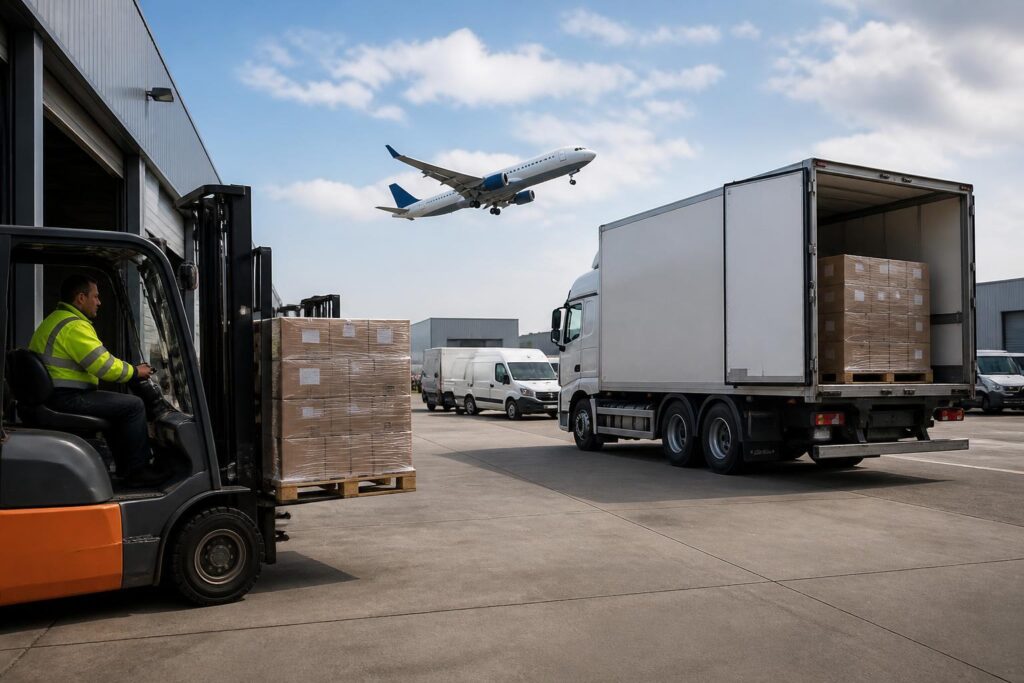
For many British businesses, the ability to deliver products quickly has become an important part of customer service. Whether a manufacturer needs an urgent replacement component, a retailer has to fulfil an unexpected order or a professional services firm must deliver confidential documents, transport delays can have consequences far beyond the cost of shipping.
Efficient logistics is no longer simply about moving goods from one location to another. It influences operational resilience, customer relationships and the ability to respond to unexpected opportunities. Companies that treat transport as a strategic business function can gain an advantage over competitors that rely entirely on conventional delivery schedules.
The Changing Role of Logistics in British Business
Traditional distribution models are designed around predictable shipment volumes, established routes and scheduled collections. These systems remain essential for everyday business operations because they allow companies to consolidate shipments and control transport expenditure.
However, modern businesses increasingly face situations that require greater flexibility.
An engineering company might discover that a missing component is preventing a production line from operating. A retailer may receive an urgent order from an important customer. An events company could find that essential equipment has been delivered to the wrong venue.
In each situation, waiting for the next scheduled collection may create additional costs or damage an existing business relationship.
This explains why flexible logistics is particularly relevant to smaller companies. Unlike larger organisations, many small and medium-sized enterprises cannot maintain extensive inventories, multiple warehouses or their own transport fleets.
Access to external courier services gives these businesses an alternative when standard distribution arrangements cannot meet an urgent requirement.
How Delivery Speed Influences Business Performance
The financial impact of transport delays depends on the industry, the value of the shipment and the consequences of missing a deadline.
For some organisations, a delayed parcel is a minor inconvenience. For others, it can interrupt an entire commercial process.
| Business sector | Typical urgent delivery requirement | Potential consequence of a delay |
|---|---|---|
| Manufacturing | Replacement machinery components | Production downtime |
| Retail | Urgent stock replenishment | Lost sales opportunities |
| Healthcare | Time-sensitive medical supplies | Disruption to scheduled services |
| Legal services | Original documents and contracts | Missed administrative deadlines |
| Construction | Specialist tools and replacement parts | Interrupted site operations |
| Events and exhibitions | Equipment, displays and promotional materials | Delays to event preparation |
The table illustrates why transport decisions should consider more than the shipping charge.
A delivery costing more than standard carriage may still be economically justified if it prevents expensive downtime or protects a valuable customer relationship.
Understanding the True Cost of a Delay
Consider a small manufacturing business that requires a replacement machine component.
If the component arrives the following day, several employees may be unable to complete their scheduled work. Orders could be delayed, machinery may remain idle and production targets might be missed.
The total financial impact could include:
- Employee hours lost during the interruption.
- Reduced production capacity.
- Additional labour costs to recover lost output.
- Contractual penalties where applicable.
- Potential damage to customer relationships.
In this situation, paying for urgent transport may be more economical than accepting the interruption.
However, the calculation works both ways. Where a shipment is not genuinely time-sensitive, conventional delivery remains the more appropriate option.
Same-Day Courier Services as a Business Solution
One way companies can manage urgent transport requirements is through dedicated same-day courier services.
Unlike conventional parcel networks, which generally move shipments through sorting facilities and established distribution routes, dedicated couriers can transport goods directly between collection and delivery locations.
This approach can be particularly useful when a shipment must reach its destination within a narrow timeframe.
Businesses looking for Same Day Courier Across the UK can explore services such as DAGO Express, which arranges dedicated transport for documents, parcels, pallets and other business shipments. Its service includes UK deliveries and connections to European destinations, with collection times and transport arrangements assessed according to the individual booking.
The central advantage of dedicated transport is flexibility. Companies can specify collection requirements, delivery deadlines and shipment characteristics rather than relying exclusively on the fixed schedules of traditional parcel services.
Nevertheless, same-day delivery is not automatically possible for every route. Distance, traffic conditions, vehicle availability, loading requirements and the time at which a shipment becomes ready all influence whether a deadline can be achieved.
Businesses should therefore confirm the planned arrival time before making commitments to customers.
Why Smaller Businesses Benefit from Flexible Transport Networks
Large corporations often operate sophisticated distribution systems, including regional warehouses and dedicated logistics departments.
Smaller enterprises typically work with fewer resources.
A growing online retailer may operate from a single warehouse. A specialist engineering company might depend on a limited number of suppliers. An independent wholesaler may need to serve customers across several regions without maintaining its own fleet.
Flexible courier arrangements allow these businesses to respond to changing circumstances without making substantial investments in vehicles or additional storage facilities.
This can support several commercial objectives.
1. Greater Operational Flexibility
Companies can arrange additional transport when demand changes unexpectedly, rather than maintaining excess delivery capacity throughout the year.
2. Better Customer Relationships
When a business can respond to an urgent customer requirement, it demonstrates reliability and a willingness to find practical solutions.
3. Reduced Dependence on Inventory
Reliable transport can support leaner stockholding arrangements, although it cannot eliminate the risks associated with supplier delays or product shortages.
4. Access to New Markets
Businesses serving customers beyond their immediate region can use external transport networks to arrange deliveries without establishing permanent facilities in every location.
These advantages are particularly relevant to the wider discussion of business innovation and entrepreneurship, where the ability to adapt operational processes often influences long-term competitiveness.
Choosing Between Standard, Express and Dedicated Delivery
Not every shipment requires the fastest available transport option.
A sensible logistics strategy distinguishes between routine deliveries, urgent consignments and genuinely critical shipments.
| Delivery option | Suitable for | Main consideration |
|---|---|---|
| Standard parcel delivery | Routine orders and predictable shipping requirements | Usually economical, but less flexible |
| Next-day delivery | Important shipments with some scheduling flexibility | Requires planning around collection deadlines |
| Same-day dedicated courier | Urgent shipments requiring direct transport | Higher cost and route-dependent availability |
| Scheduled dedicated transport | Valuable or specialist goods requiring planned handling | Vehicle suitability and precise arrangements |
| Freight transport | Pallets, heavy equipment and larger consignments | Loading facilities, capacity and handling requirements |
The choice should be based on the commercial importance of the shipment rather than speed alone.
For example, a business sending routine office supplies is unlikely to benefit from dedicated transport. A manufacturer waiting for a component that will restart a production line may have a compelling reason to choose it.
Five Practical Ways to Improve Business Logistics
Improving delivery performance does not necessarily require expensive software or a complete restructuring of existing operations. Several practical changes can make a substantial difference.
Assess Which Shipments Are Business-Critical
Businesses should identify the products, materials and documents whose delayed arrival would create the greatest operational problems.
This allows managers to establish clear rules for when urgent transport is justified.
Maintain Accurate Shipment Information
Incomplete delivery addresses, incorrect package dimensions and missing contact details can delay collection and delivery.
Companies should ensure that shipment records contain accurate weights, dimensions, access instructions and receiving hours.
Build Relationships with Suitable Transport Providers
Rather than searching for a courier only after an emergency occurs, businesses can identify appropriate providers in advance.
Knowing which services can accommodate particular shipment sizes, destinations and handling requirements reduces uncertainty when urgent transport becomes necessary.
Improve Communication Between Departments
Purchasing, sales, warehouse operations and customer service should have access to consistent information about dispatch deadlines and shipment priorities.
Poor internal communication can create delays even when a suitable courier is available.
Measure Delivery Performance
Tracking key indicators helps companies identify recurring problems and evaluate whether changes are producing measurable benefits.
Useful metrics include on-time delivery rates, transport costs per shipment, delivery-related complaints and the frequency of emergency bookings.
Technology Is Changing Transport Management
Digital platforms have made it easier for businesses to compare delivery options, request quotations and monitor shipments.
Instead of relying entirely on telephone calls and manual paperwork, companies can increasingly manage transport requests through centralised booking systems.
Shipment tracking can also improve communication with customers, particularly when delivery deadlines are important.
For growing businesses, the most valuable technologies are often those that reduce administrative work and prevent avoidable errors.
For example, integrating order management and shipping information can reduce the need to enter the same customer details repeatedly.
Transport performance data can also reveal patterns. A business might discover that urgent shipments regularly originate from one supplier or that a particular product category generates unusually high delivery costs.
These findings can inform broader purchasing, stock management and operational decisions.
The relationship between technology and commercial efficiency reflects the wider importance of disruptive technologies shaping industries.
Balancing Delivery Speed, Cost and Sustainability
Fast delivery provides clear operational advantages in certain circumstances, but it should not become the default choice for every shipment.
Dedicated journeys may use more transport capacity per item than consolidated delivery networks. Consequently, businesses should consider both the commercial need for speed and the environmental implications of their shipping decisions.
Several measures can help establish a more balanced approach:
- Consolidate routine orders whenever practical.
- Reserve urgent transport for shipments with a clear business justification.
- Reduce unnecessary packaging without compromising product protection.
- Improve purchasing forecasts to avoid preventable emergency orders.
- Review delivery failures to identify opportunities for better planning.
A sustainable logistics strategy is not simply about selecting the slowest or cheapest delivery service. It involves choosing the appropriate transport method for each situation while avoiding unnecessary journeys.
Logistics as Part of a Long-Term Business Strategy
As companies expand, delivery requirements tend to become more complex. Customer locations change, order volumes fluctuate and suppliers may operate across different regions or countries.
Businesses that consider logistics only after a problem occurs often have fewer options available when deadlines become critical.
By contrast, organisations that incorporate transport planning into their wider business strategy can establish clearer procedures, assess risks and respond more effectively to unexpected challenges.
This does not mean every company needs a dedicated logistics department. For smaller enterprises, straightforward processes, reliable transport partners and accurate information may be sufficient.
The most important step is recognising that delivery performance contributes directly to operational stability and customer satisfaction.
Conclusion: Reliable Logistics Supports Business Growth
Fast transport alone does not guarantee commercial success. Product quality, competitive pricing, customer relationships and effective management remain fundamental.
Nevertheless, the ability to deliver essential goods at the right time can protect revenue, prevent operational disruption and strengthen customer confidence.
For British businesses facing unpredictable demand and increasingly complex supply chains, flexible logistics offers a practical way to improve resilience.
Companies that combine sensible inventory management, reliable standard distribution and access to urgent courier services are better positioned to handle unexpected challenges without allowing transport problems to dictate their commercial decisions.